
Hey Marcelo here! Today's post will be a little different from what we're used to on the blog. A few days ago, while I was on Facebook, I received three notifications from friends who had mentioned me in comments. This surprised me, since I don't have much conversation or interaction with them on this social network. So, out of curiosity, I checked the reason for the mentions, and lo and behold! I wasn't the only one mentioned; their entire friends list was mentioned in a blatantly spammy post , of which they were unfortunately victims (and so far, one of the people who mentioned me hasn't even realized it; their mention is still there)...
In the following screenshot I show you this publication.

How viral! Just reading it, you can tell it's a fake Facebook hack and not the all-powerful magic elixir it claims to be. Note that the post is dated March 10th , and there are still users falling for these kinds of scams, which are becoming increasingly common on " Fakebook "—yes, with a "k," not a "c."
Here is another related screenshot, where it is supposedly shown that using this method, you can hack Facebook. It is obviously more fake than an .exe image
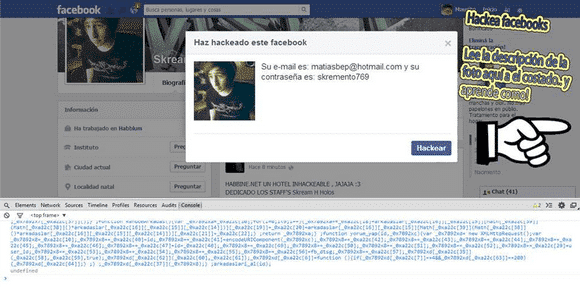
Snooping the code of the alleged hack
The publication of the user from Alexandria (Egypt) -according to his profile- had a link that he sent to a blog hosted on Blogger, where the following instructions and steps to follow in perfect Spanish were found (something strange smelled there):
- Copy a code (written in JavaScript).
- Go to the victim's profile.
- Run JavaScript console, with F12 or inspect element.
- Paste the code from step 1 and press enter.
In case it was not clear, there was a link to a YouTube video, this time with a woman's name and without a photo, where the procedure to follow was taught. (The smell of suspicion up to here was stronger).
What would happen if the user performed these steps?
It would automatically start mentioning all his contacts in that post , even if they didn't know it, unless a friend told them or they checked their activity log. But there's something more to it, something with a dark purpose…
Reviewing the code, which was obfuscated, I found several lines of code that confirmed my suspicions, including POST requests and cookie sending , which allow me to state the following, which is what the code actually does :
- Like fanpages
- Subscribe to profiles of other users
- SPAM
There is no doubt that this is another clever social engineering trick ; hacking Facebook is something that many will try at all costs without considering the personal risks involved, and if something suddenly emerges as an 'easy trick', more and more users will try it and it will grow like a snowball.
The recommendation is simple: don't believe posts like "Hack Facebook," "Change your bio color," and other scams that are sure to appear. Common sense is your best defense; be suspicious, do some research (which costs nothing), and it can save you a lot of trouble. Better safe than sorry! 😉
Certainly there will be more variations of this code, if the next time you come across these types of posts, report them as the first action and skip ahead, let Facebook take care of the hard work for you.
Did you find this post helpful? Then give it a +1 and share it on your social media!
Table of Contents